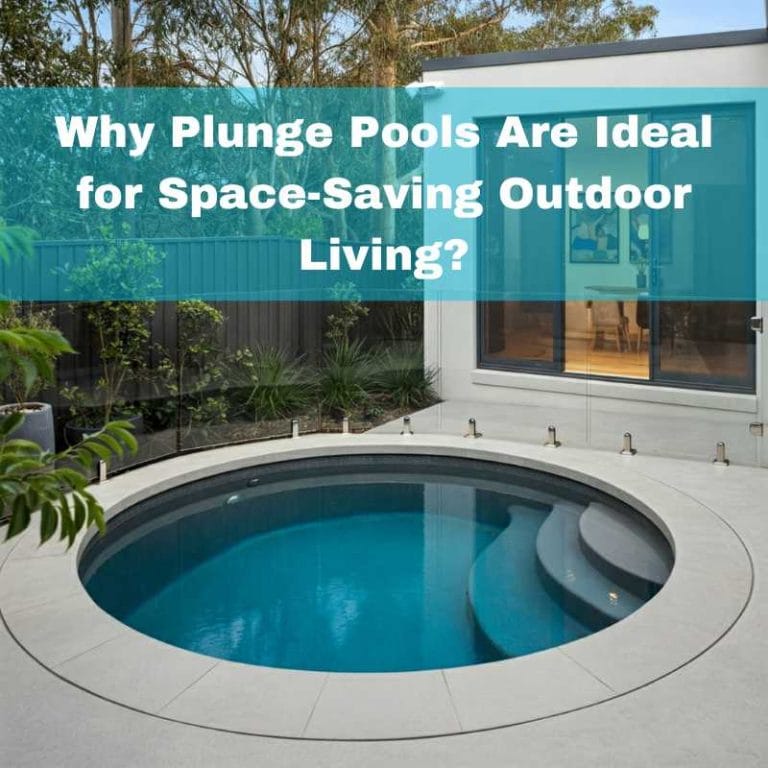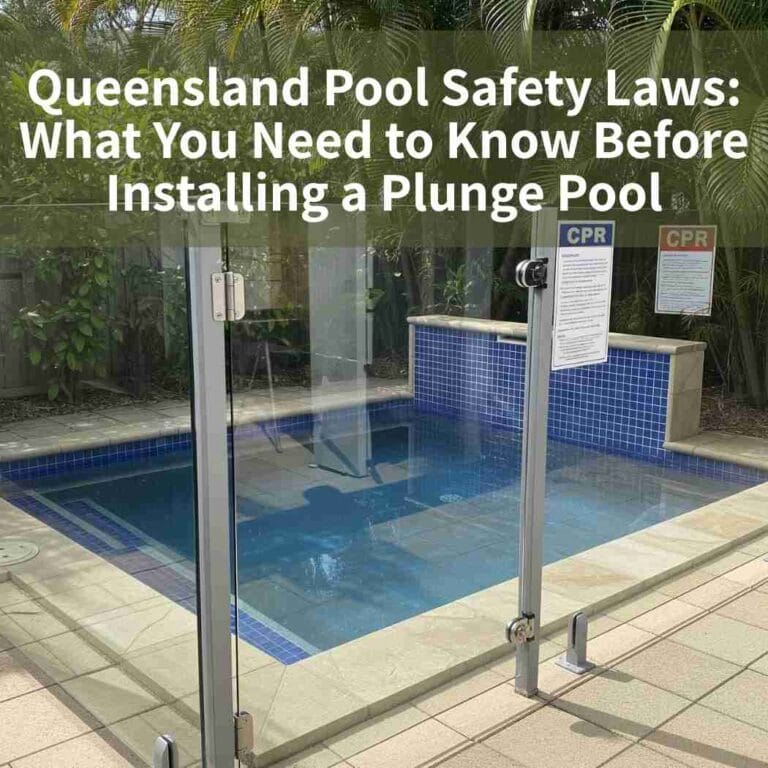
Clay soil Brisbane is highly reactive, meaning it expands when wet and shrinks when dry, creating ground movement that can stress pool structures, crack slabs, and shift footings over time. Understanding how this soil behaves before you install a plunge pool is one of the most important steps you can take to protect your investment.
Key Takeaways
- Brisbane’s clay-heavy soil is classified as reactive, and its movement is one of the top causes of structural issues in pool installations.
- Soil testing before any excavation is essential, not optional, for accurate design and budgeting.
- Precast and custom concrete pools respond differently to reactive soils, and choosing the right type matters enormously.
- Slab thickness, reinforcement, and drainage design all need to account for clay movement.
- Above-ground and deck-mounted pool options can sidestep many clay-related excavation problems.
- Getting your soil classification report early can save you thousands in unexpected remediation costs.
Why Brisbane’s Soil Behaves the Way It Does
Brisbane sits on a geological mix that includes significant deposits of reactive clay, particularly in the western and southern suburbs. Neighbourhoods like Ipswich corridor, Kenmore, Oxley, and parts of the Redlands are especially known for highly plastic clay soils. These soils are classified by Engineers Australia under a reactivity classification system ranging from slightly reactive (Class S) through to extremely reactive (Class E), with most Brisbane backyards falling somewhere in the Class M to Class H range.
The core problem with clay soil Brisbane builders face is the volume change cycle. During a dry summer, clay contracts and pulls away from structures. After heavy rainfall, it swells back. Repeating this cycle year after year creates ongoing lateral and vertical pressure against pool walls, footings, and surrounding slabs. Without the right engineering response, this movement causes cracking, joint failure, and in severe cases, structural compromise of the entire pool shell.
The Australian Building Codes Board mandates site classification as part of the building approval process in Queensland, which means any licensed builder must account for soil reactivity before pouring a slab or setting a pool shell.
How Clay Soil Affects Pool Excavation and Costs
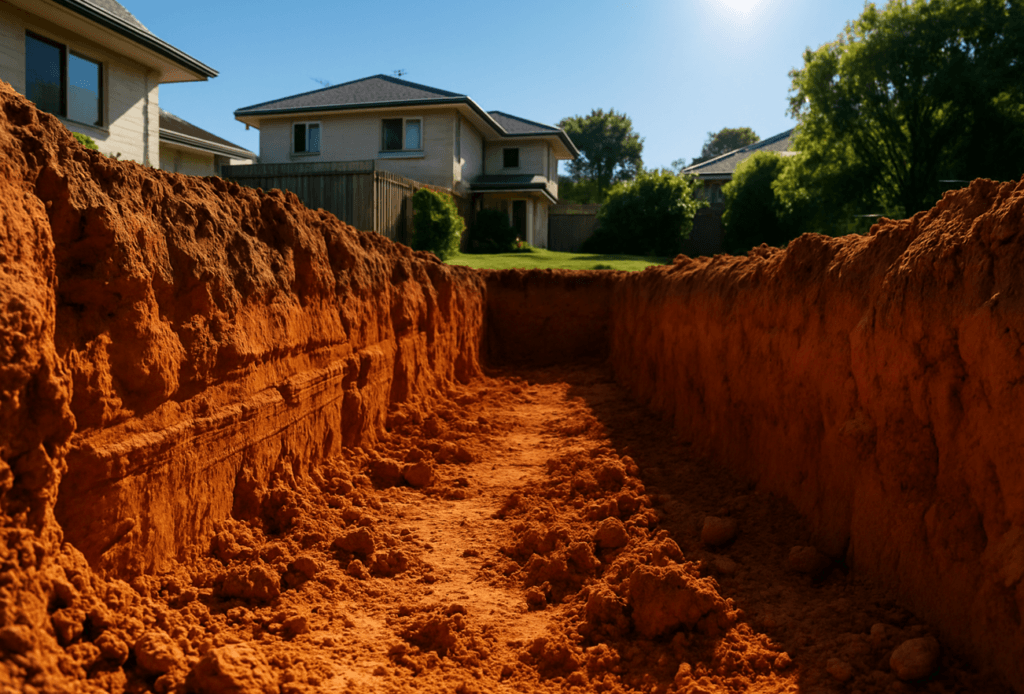
Excavating through clay is slower, heavier work than digging through sandy or loamy soils. Clay clings to excavation machinery, requires more frequent bucket cleanouts, and can take significantly longer to remove from a tight suburban block. This directly affects labour time and machinery hire, which flows through to your overall project budget.
When you look at plunge pool cost Brisbane breakdowns, soil type is one of the key variables that separates a straightforward installation from a complex one. A project on reactive clay may require:
- Engineered footing designs rather than standard strip footings
- Additional concrete volume to compensate for the soil bearing capacity
- Geotechnical reports from a licensed engineer
- Extended excavation time due to the weight and adhesion of clay
- Controlled fill or compacted road base around the pool shell to reduce differential settlement
A geotechnical investigation, which typically costs between A$800 and A$2,500 depending on scope, is strongly recommended before you commit to a pool type or footprint. This report tells your engineer exactly what the soil will do and what structural response is required.
The Queensland Building and Construction Commission (QBCC) outlines the licensing and structural requirements that apply to pool installations across the state, and these requirements become more stringent as soil reactivity increases.
Precast Versus Concrete Pools on Reactive Clay
This is the central decision most Brisbane homeowners face once they understand their soil conditions. Each pool type responds to clay movement differently.
Precast Plunge Pools
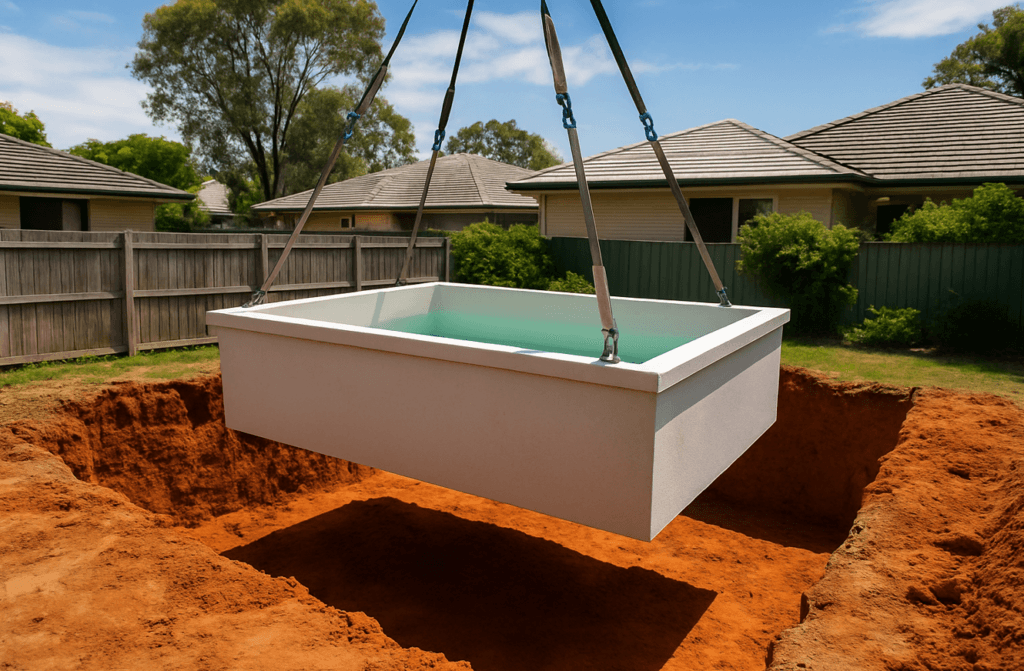
Precast pools are manufactured off-site as a single, monolithic shell. Because the structure is already fully cured and rigid when it arrives on site, it behaves as one unit under ground movement. This can be an advantage in reactive soil conditions, as the shell moves as a whole rather than cracking at multiple independent pour joints.
The advantages precast plunge pools offer in reactive soil environments include a uniform shell strength, faster installation (which minimises the time the excavation is open and exposed to rain-driven clay expansion), and factory-quality finish that does not depend on site curing conditions.
However, precast pools are heavy. Transport logistics and crane placement can be complicated on tight Brisbane lots with narrow side access or overhead power lines. Your site access must be assessed before ordering.
Custom Concrete Pools
Custom concrete pools, whether shotcrete or poured, are built in place. This allows complete design flexibility in shape and depth, which matters when dealing with an irregular block or an unusual soil profile. A well-engineered concrete shell with appropriate reinforcement and waterproofing can perform extremely well on reactive clay, provided the design accounts for soil movement from the start.
A round concrete pool design, for example, distributes lateral earth pressure more evenly around the shell compared to a rectangular pool with flat walls, which can reduce stress concentration points in reactive soil conditions. Similarly, a concrete round pool configuration avoids the sharp corners where cracking most often initiates under differential settlement.
The trade-off is that concrete pools take longer to install, and the longer the excavation sits open in clay soil, the greater the risk of collapse or swelling at the base, particularly after rainfall.
| Feature | Precast Pool | Custom Concrete Pool |
|---|---|---|
| Soil movement response | Moves as single unit | Risk at pour joints if not engineered well |
| Installation speed | Faster (crane set in one day) | Slower (weeks for shell construction) |
| Shape flexibility | Limited to standard moulds | Fully custom |
| Cost on reactive soil | Often lower due to shorter site time | Can increase with added engineering |
| Access requirements | Crane + wide site access needed | Standard machinery access |
| Best suited for | M to H class clay | All classes with correct engineering |
Slab and Structural Considerations Around the Pool
The pool shell is not the only structure affected by clay. The surrounding slab, coping, retaining walls, and any adjacent structures all need to be designed with reactive soil in mind. Getting concrete slab thickness right around your pool is critical, because an undersized slab will crack and heave as the clay beneath it cycles through wet and dry seasons.
In Class H or Class E soil, a residential slab would typically need to be a minimum of 100mm to 120mm thick with a reinforcing mesh, but engineered slabs around pools may require more depending on the load bearing requirements and the proximity to the pool wall. Any slab that spans across the clay directly should be isolated from the pool shell using a flexible control joint, allowing independent movement without transferring stress between the two structures.
Drainage design is equally important. Water that pools near the excavation zone after rain accelerates clay swelling. A well-planned surface drainage system around your pool area reduces saturation events and keeps soil movement more predictable and manageable over the long term.
Above-Ground and Deck-Mounted Options for Challenging Sites
If your site has extreme clay reactivity, very shallow bedrock beneath the clay layer, or difficult access for excavation machinery, above-ground installation or a deck-mounted pool may be a more practical and cost-effective solution.
A plunge pool on deck configuration avoids most of the clay-related excavation risks entirely. The pool structure sits above grade, supported by an engineered deck or subframe, which means clay swelling and shrinkage beneath the pool does not directly stress the pool shell. The deck itself still needs to be engineered for the relevant soil class, but the structural risk profile is quite different from an inground installation.
This approach is increasingly popular on Brisbane’s hillside lots where cut-and-fill creates unstable clay fills, or where the slope makes inground excavation impractical without major retaining work.
Things to Know
- Reactive clay can move by several centimetres vertically over a single wet-dry cycle in Brisbane, which is enough to crack poorly designed structures.
- Soil classification must be done by a licensed geotechnical engineer, not estimated based on the visual appearance of the soil at the surface.
- Clay soil becomes more problematic when vegetation is removed near the pool zone, as tree roots previously drawing moisture from the soil are no longer present to moderate moisture levels.
- Pool fill water management matters: if you backfill around the pool shell with the excavated clay, you reintroduce reactive material directly against the structure. Controlled fill is a better choice.
- Not all Brisbane suburbs have uniform soil; even within a single block, you may encounter varying clay depths depending on site history and previous earthworks.
- Plunge Pools Brisbane offers precast plunge pool installation, custom concrete plunge pools, above-ground plunge pools, and inground plunge pool options, providing solutions across the full range of soil conditions and site types.
Conclusion
Clay soil in Brisbane presents real and measurable challenges for any pool installation, but they are challenges that experienced builders and engineers deal with successfully every day. The key is knowing what you are dealing with before you start, not after the first dry season exposes a crack in your coping. Get the soil report, choose a pool type matched to your conditions, and work with a supplier who can demonstrate their structural design approach for reactive soils.
Plunge Pools Brisbane brings installation expertise across precast, custom concrete, above-ground, and inground pool types, meaning there is a solution available regardless of what your soil report reveals. Start with the geotechnical investigation, then bring that data to your consultation so every decision that follows is grounded in the actual conditions under your block.
Ready to Assess Your Site Before Committing?
Before you choose a pool shape, size, or supplier, book a geotechnical investigation for your Brisbane block. Take the soil classification report to your pool installer and ask them directly how their design responds to your specific soil class. If they cannot give you a specific, engineered answer, that is a red flag. Plunge Pools Brisbane works with licensed engineers to match pool type and structural design to site conditions, so the structure you install is built for the ground it sits in, not just the ground in a brochure.
Frequently Asked Questions
Does clay soil in Brisbane always require special engineering for a pool?
Yes, reactive clay soil in Brisbane almost always requires some level of additional engineering beyond standard pool installation.
The extent of that engineering depends on the soil classification result from a geotechnical report. Class M soils may require modest changes to footing design, while Class H or E soils require full structural engineering input.
How much extra does clay soil add to a Brisbane pool installation?
Clay soil can add anywhere from A$2,000 to A$15,000 or more to a pool project, depending on reactivity class and site conditions.
This includes geotechnical investigation fees, additional concrete, engineered footing designs, and potentially the cost of importing controlled fill to replace excavated clay around the shell.
Can a precast plunge pool crack in Brisbane clay?
A properly installed precast plunge pool can handle reactive clay movement well, but installation quality and bedding material are critical.
If the pool is not bedded on a correctly compacted and levelled base, or if clay is used as backfill directly against the shell, movement can stress fittings, pipes, and the shell over time. According to healthdirect.gov.au, pool water hygiene can also be affected when structural movement compromises pipe connections, so maintaining structural integrity protects both the asset and the users.
Is an above-ground plunge pool better than inground on reactive clay?
An above-ground pool avoids direct contact between the pool shell and reactive clay, which removes one of the main risk pathways associated with clay soil movement.
It is not always the better option for aesthetics or resale value, but on extreme-reactivity sites or difficult-access blocks, it is a practical and often more affordable solution that still delivers the thermal and recreational benefits of a plunge pool.
How do I find out my Brisbane property’s soil classification?
You need to commission a geotechnical site investigation from a licensed geotechnical engineer, who will take soil samples and issue a classification report under Australian Standard AS 2870.
You can find licensed geotechnical engineers through the Engineers Australia directory or through your local council’s building services team. Most pool builders will request this report before finalising a structural design.