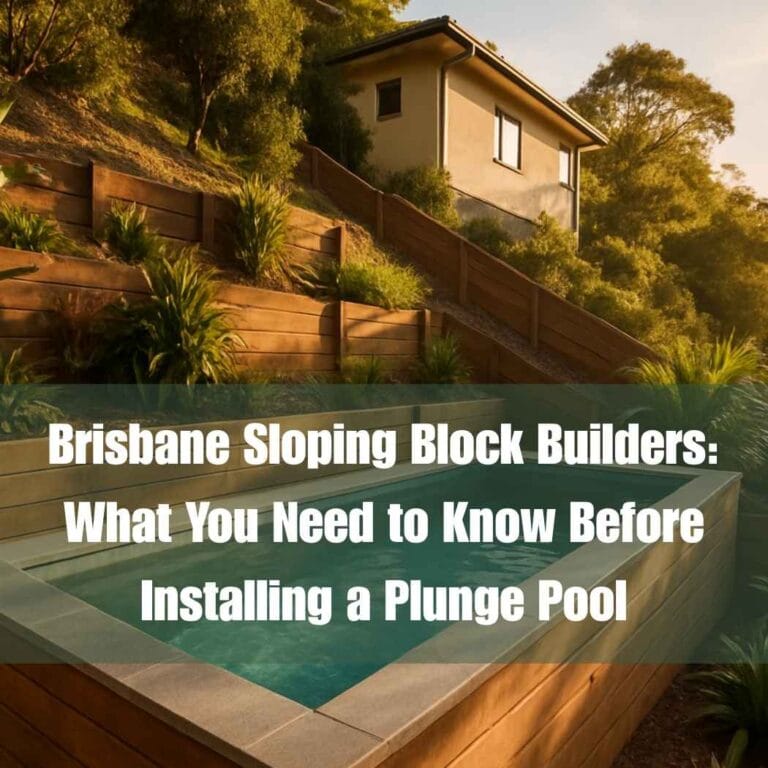
Brisbane sloping block builders specialise in transforming steep, awkward terrain into functional outdoor living spaces, including plunge pool installations. If your property sits on a gradient, understanding the structural, engineering, and design considerations upfront will save you thousands and prevent costly mistakes down the track.Regenerate section
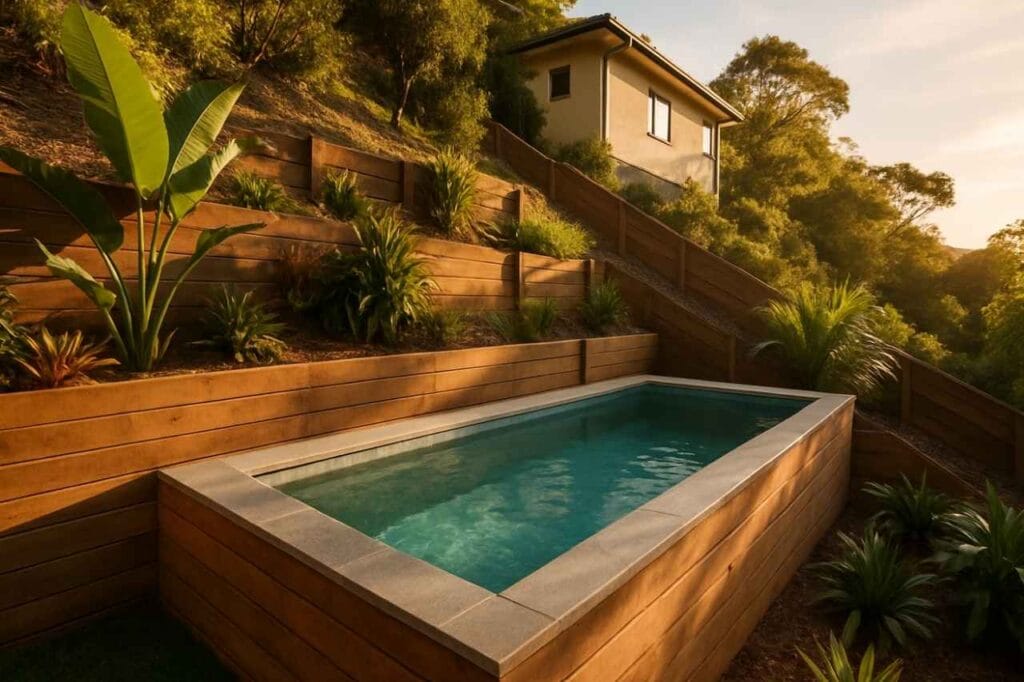
Key Takeaways
- Sloping blocks in Brisbane require additional engineering work, including retaining walls, excavation, and drainage planning, before pool installation can begin.
- Precast plunge pools are often the most cost-effective and time-efficient option for sloped sites due to their factory-controlled manufacturing process.
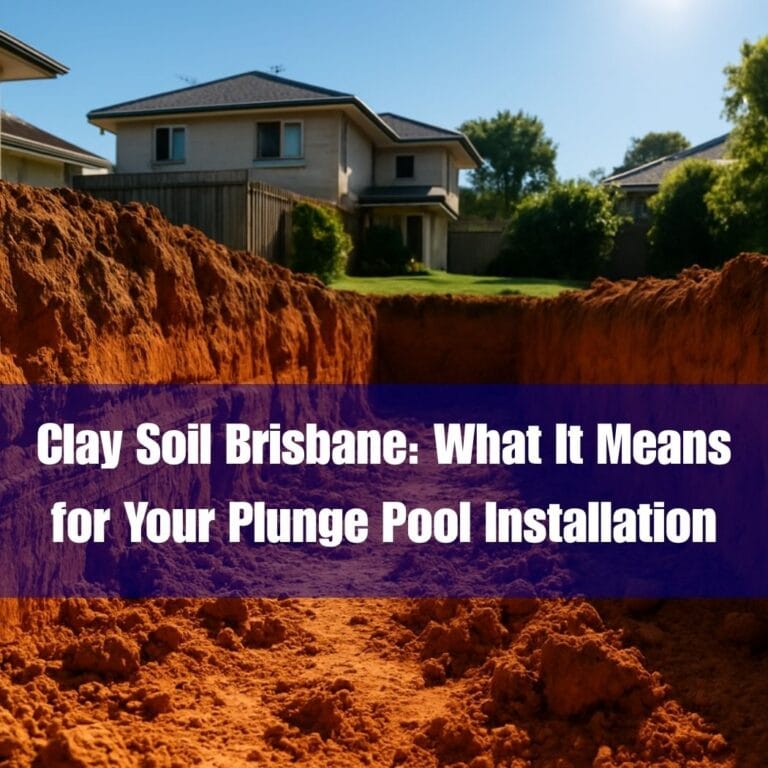
- Clay soil, which is common across Brisbane’s hillside suburbs, significantly affects excavation depth, pool placement, and long-term structural stability.
- Concrete slab thickness beneath or around your pool must be engineered to suit the slope angle and soil conditions, not just standard residential specifications.
- Pool shape, including round or rectangular options, can influence how well a pool integrates into a sloped site’s retaining and landscaping design.
- Getting accurate quotes early, including sitework allowances, is essential because sloped block costs can vary dramatically from flat-block estimates.
Why Sloping Blocks in Brisbane Present Unique Pool Challenges
Brisbane’s topography is genuinely varied. Suburbs like Paddington, Fig Tree Pocket, Brookfield, Pullenvale, and parts of the Samford Valley feature blocks with gradients ranging from a gentle five degrees to near-vertical cuts. This diversity is part of the city’s character, but it also means that installing a pool on a Brisbane slope is a fundamentally different project to the same job on a flat suburban block in Logan or the Gold Coast hinterland.
The core challenge is gravity. Water, soil, and structural loads all behave differently on a slope. A pool shell, once filled, can weigh 40,000 kg or more. On level ground, that weight distributes relatively evenly. On a sloped block, lateral pressure becomes a serious engineering concern. Without correctly designed retaining walls and drainage systems, a pool installation can destabilise the hillside around it, leading to soil movement, cracking, and in extreme cases, structural failure.
Beyond structural risk, sloped blocks add cost at almost every stage. Excavation takes longer and requires more specialised machinery. Spoil removal is greater. Retaining walls must be built to council and engineering specifications. Access for concrete trucks and cranes may be limited. All of these factors compound when you are working with clay soil, which is common across Brisbane’s hillside suburbs and which expands and contracts with moisture changes in ways that sandy or loamy soils simply do not.
How Experienced Builders Approach Sloped Site Assessments
Before a single shovel touches the ground, a credible builder will conduct a thorough site assessment. This is not a formality. It is the step that separates accurate quotes from ballpark figures that balloon by 30% once excavation begins.
A proper sloped site assessment covers:
- Gradient measurement: The angle of the slope across the intended pool footprint and surrounding area.
- Soil testing: Identifying whether the site contains clay, fill, rock, or mixed substrates. Healthdirect may be your go-to for health queries, but for soil classification in Queensland, builders typically reference the Queensland Government’s land and soil capability framework.
- Retaining wall requirements: What height, material, and engineering certification will council require.
- Drainage mapping: Where stormwater currently flows and how the pool installation will redirect or intercept that flow.
- Access audit: Whether the site can accommodate the machinery needed, or whether additional costs like crane hire will apply.
Plunge Pools Brisbane, which offers precast plunge pool installation, custom concrete plunge pool, inground plunge pool, and above ground plunge pool services, builds this site assessment process into every quote. The reason is straightforward: guessing at sitework costs on a slope is how projects end up over budget and under-engineered.
Precast vs. Custom Concrete: Choosing the Right Pool for a Sloped Block
One of the most significant decisions you will make is whether to go with a precast plunge pool or a custom in-ground concrete pool. Both have real merit, and the right choice depends on your site, your budget, and your timeline.
| Feature | Precast Plunge Pool | Custom Concrete Pool |
|---|---|---|
| Installation time | 1-3 days (shell placement) | 4-10 weeks |
| Structural flexibility | Fixed sizes and shapes | Fully customisable |
| Cost on sloped sites | Generally lower | Higher due to formwork |
| Suitability for steep slopes | Excellent with correct engineering | Excellent but more costly |
| Long-term durability | Very high (factory quality control) | Very high (when well built) |
| Access requirements | Crane access often needed | Standard machinery access |
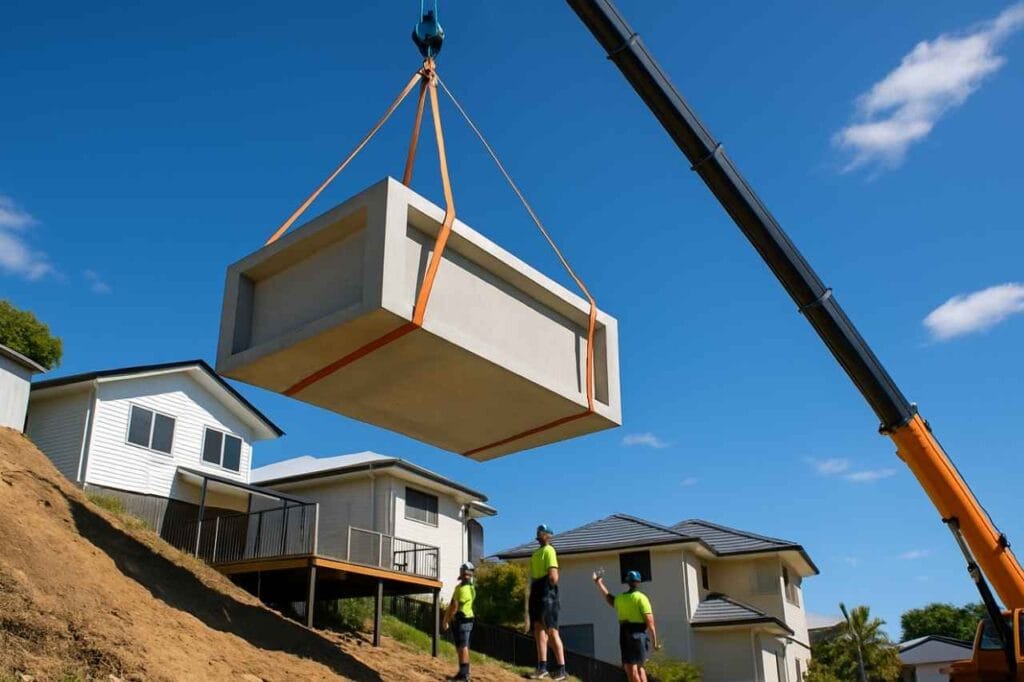
For many Brisbane homeowners with sloped blocks, the advantages precast plunge pools offer are particularly relevant. Because the shell is manufactured off-site under controlled conditions, there is no risk of rain delays, on-site concrete curing issues, or formwork problems caused by the slope itself. The pool arrives ready to place, which dramatically reduces the time your yard is torn up and the risk of complications from soil exposure.
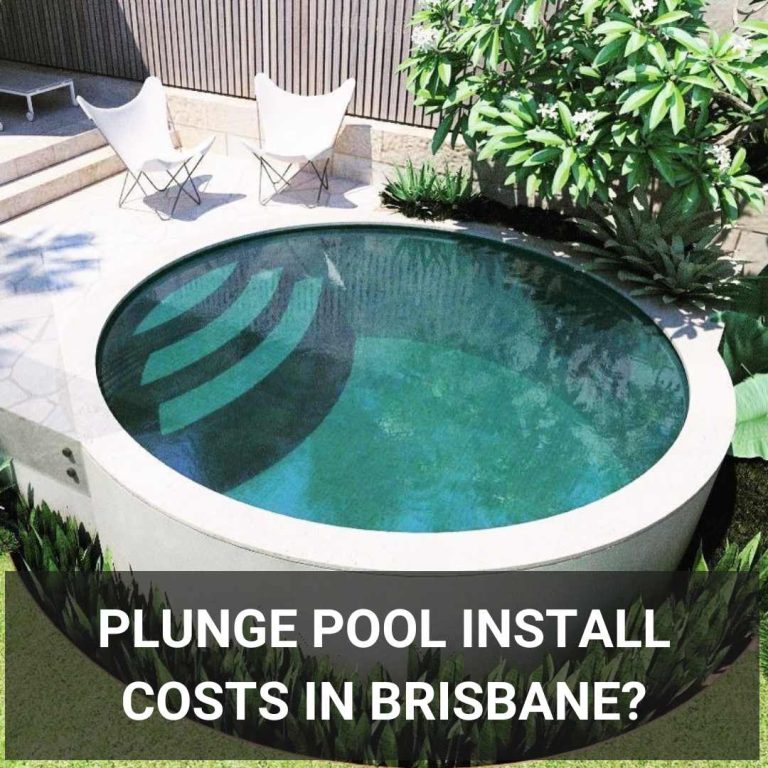
That said, custom concrete pools allow shapes and dimensions that precast cannot match. If you have a narrow terrace on a sloped block, a round concrete pool custom-formed to fit that specific footprint might be the better option. The trade-off is time, cost, and the additional complexity of pouring concrete on a gradient.
For detailed guidance on how precast pools perform specifically on hillside terrain, the information on precast plunge pools on sloped sites provides a practical breakdown of installation methodology.
Engineering and Structural Considerations You Cannot Skip
Structural engineering is non-negotiable on sloped blocks. Brisbane City Council, along with surrounding councils including Moreton Bay, Redland City, and Logan, require building approval for pools, and that approval process includes a review of structural plans for anything built on a non-standard site.
Two structural elements matter most on sloped blocks:
1. Retaining Walls
A pool on a slope almost always requires a retaining wall either below or beside the pool shell. These walls must be engineered to withstand both the lateral pressure of the soil behind them and the hydrostatic pressure that builds up when the ground becomes saturated after rain. According to Brisbane City Council’s retaining wall guidelines, walls over one metre in height require a building approval, and taller walls require a structural engineer’s certification.
2. Concrete Slab Thickness
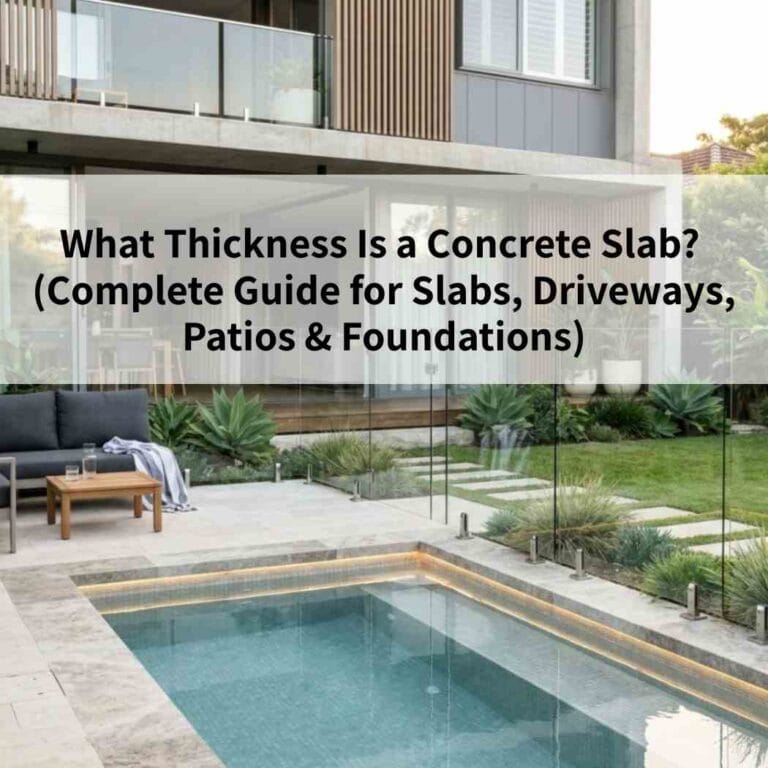
The base beneath your pool and the surrounding surrounds slab must be designed for the specific load and slope conditions. Standard residential slab specifications are not appropriate for sloped sites, particularly where clay soils are involved. Understanding concrete slab thickness requirements is critical before finalising your design, as undersized slabs on sloped sites can crack, shift, or allow the pool to move over time.
The Australian Building Codes Board provides the regulatory framework that governs structural design for residential pools, and your engineer and builder must work within those standards.
What It Actually Costs on a Sloped Block in Brisbane
Cost is where many homeowners get a rude shock. A flat-block pool quote and a sloped-block pool quote for the same pool can differ by A$10,000 to A$30,000 or more, depending on the severity of the slope, the soil type, and the retaining wall requirements.
The major cost categories unique to sloped sites are:
- Additional excavation: Steep slopes require more cut-and-fill work, and rock or clay can significantly increase machine time.
- Retaining walls: Engineered retaining walls in concrete or steel start from around A$500-$800 per lineal metre for modest heights, and much more for walls over 1.5 metres.
- Crane hire: Precast pools on difficult-access sites need a crane, which can add A$2,000-$5,000 to the project.
- Drainage systems: Redirecting stormwater around a pool on a slope requires properly engineered drainage that a flat site simply does not.
- Engineering certification fees: Expect to pay A$1,500-$4,000 for a structural engineer’s input and certification, depending on complexity.
For a realistic understanding of what a plunge pool project costs before sitework factors are applied, reviewing the breakdown of plunge pool cost brisbane gives you a solid baseline from which to add sloped-site allowances.
According to the Australian Bureau of Statistics, South East Queensland has seen sustained population growth over the past decade, which has driven significant residential development on hillside blocks that were previously considered too difficult to build on. This has created a growing demand for builders with genuine sloped-block experience.
Things to Know
- Brisbane City Council requires a building approval for retaining walls over one metre high, and combined retaining wall and pool projects often trigger a more detailed development application process.
- Not all pool builders are equipped to work on sloped sites. Ask specifically about their sloped-block project history and request photos of comparable installations.
- The orientation of the slope matters for sun access. A south-facing slope in Brisbane may leave your pool in shade for much of winter, which affects your heating costs significantly.
- Fill material used to level a site before pool installation must be properly compacted and tested, as poorly compacted fill is one of the most common causes of pool movement and cracking over time.
- Tree roots on sloped blocks, particularly from eucalypts and figs common in Brisbane’s older suburbs, can compromise both retaining walls and pool shells. A builder should assess root zones before finalising pool placement.
- Some lenders treat sloped-block builds differently for valuation purposes. If you are financing the project through a construction loan, discuss this with your broker early.
Conclusion
Brisbane sloping block builders bring a specific set of skills that flat-site pool contractors simply do not need. The combination of structural engineering knowledge, excavation expertise, retaining wall experience, and drainage management is what separates a builder who can confidently quote your hillside block from one who is guessing. Plunge Pools Brisbane specialises in exactly this kind of project, offering precast, custom concrete, inground, and above ground plunge pool installations across Brisbane’s most challenging terrain.
If your block has a slope, start with a physical site assessment, get your soil conditions documented, and ask your builder direct questions about their sloped-site project history. The investment in getting these basics right before you commit to a design will pay for itself many times over by the time your pool is filled and ready to use.
Ready to Get a Site-Specific Assessment for Your Block?
Contact Plunge Pools Brisbane directly and request a sloped-site assessment for your specific block. Bring your site survey or certificate of title dimensions, note the approximate gradient, and be ready to discuss your soil type if you know it. The more detail you provide upfront, the more accurate your initial quote will be. Do not rely on a phone quote for a sloped block. A physical inspection is the only way to produce a number you can actually build a budget around.
You can also check the ABC News coverage on Queensland’s building boom to understand broader construction timelines and material cost pressures that are currently affecting pool projects across South East Queensland.
Frequently Asked Questions
Do sloping blocks in Brisbane always require a structural engineer for a pool installation?
Not always, but in most practical cases on significant slopes, a structural engineer’s input is required or strongly advisable.
Brisbane City Council’s building approval process for pools on sloped sites typically triggers a structural assessment once retaining walls exceed one metre or where the slope gradient is steep enough to affect the pool’s structural design. Even where it is not strictly mandated, engaging an engineer protects you from long-term liability.
How long does a plunge pool installation take on a sloped Brisbane block?
The installation timeline for a sloped block is typically two to four weeks longer than a comparable flat-block project, depending on retaining wall complexity.
Excavation, retaining wall construction, and drainage work all add time before the pool shell can even be placed. Precast options can reduce the pool-placement phase to a single day, but the sitework still takes time regardless of the pool type you choose.
Can I install an above ground plunge pool on a sloped block to avoid excavation?
An above ground pool can reduce excavation requirements, but it does not eliminate the need for a level, structurally sound base.
On a sloped block, even an above ground installation requires a levelled platform, which often means retaining wall construction or concrete pads. The savings versus a fully inground pool exist but are sometimes smaller than homeowners expect.
Will a sloped block pool add value to my Brisbane property?
In most cases, yes, particularly in hillside suburbs where outdoor entertaining space is limited and a well-designed pool maximises the usable footprint of the block.
A Queensland-based property valuer would typically assess the pool’s contribution to value based on the quality of the installation, the integration with landscaping, and the suburb’s buyer demand. Poorly executed sloped-block pools can actually reduce value if structural issues are visible.
What approvals do I need before starting a pool on a sloped block in Brisbane?
You will need a building approval from Brisbane City Council (or your relevant local council), a pool fence compliance certificate, and potentially a development application if retaining walls are significant.
The Queensland Building and Construction Commission also requires that the work be carried out by a licensed contractor. Confirming your builder holds the appropriate QBCC licence before signing any contract is an essential step.