Brisbane’s hilly terrain, especially in suburbs like Paddington, Bardon, Kenmore, and Ferny Grove, means thousands of homeowners are working with blocks that drop, rise, or cut across at awkward angles. For many of them, a precast plunge pool is the most practical option available. Unlike poured concrete or fibreglass shells, precast pools arrive as finished, cured units that are craned into position, which removes a significant amount of on-site construction time. But on a sloped block, the work that happens before and after that crane arrives is where most of the planning, cost, and effort lives.
This article walks you through exactly what that process involves, what it costs, and how to make smart decisions at every stage.
Why Sloped Sites Create Unique Challenges for Precast Pool Installation
A precast pool is a rigid, pre-manufactured concrete unit. It needs a flat, stable, load-bearing base to sit on. When your yard slopes, that base does not exist naturally. You have to create it, and the steeper the slope, the more engineering work that takes. The main challenges you will face on a sloped Brisbane block include:
- Excavation complexity: You are not just digging a hole. You are potentially cutting into a hillside on one side while the other side sits exposed above grade. This changes the volume of soil removed and how it needs to be managed.
- Retaining walls: Once you excavate, the surrounding soil needs to be held back. On a slope, this often means retaining walls on two or three sides of the pool, not just one.
- Water drainage: Brisbane receives significant seasonal rainfall. On a slope, water naturally runs downhill toward the lowest point. If that low point is near your pool installation, you need a drainage plan that directs stormwater away from the pool shell and surrounding paving.
- Access for crane and delivery: Precast pools are heavy, typically between 8 and 20 tonnes depending on size. Getting a crane onto a steep, narrow Brisbane block with mature trees, power lines, or tight street access adds a logistical layer that needs to be scoped before you commit to a quote.
- Soil type: Brisbane’s geology varies significantly. Clay-heavy soils in many western suburbs shrink and swell with moisture changes, which affects footing design and long-term stability.
The Queensland Building and Construction Commission publishes guidelines on pool installation and owner-builder requirements that are worth reviewing early in your planning process.
How the Installation Process Actually Works on a Sloped Block
Understanding the step-by-step process helps you ask the right questions when getting quotes and avoids surprises mid-project.
1. Site Assessment and Engineering
Before anything else, a competent installer will carry out a site inspection and, in most cases, engage a structural or geotechnical engineer. This is not optional on a sloped block. The engineer assesses soil bearing capacity, slope angle, and what retaining solution is appropriate. In Brisbane, a slope of more than 1 in 4 typically triggers more complex engineering requirements.
2. Excavation and Base Preparation
The excavation team cuts into the slope to create a level platform. The dimensions need to accommodate not just the pool shell but also the required clearance on all sides for backfilling, plumbing, and any retaining structures. Soil from the cut is either removed from site or redistributed, depending on your landscaping plan.
A compacted sand or concrete base is prepared at the bottom of the excavation. Getting this level and stable is critical. Even minor unevenness under a precast unit can cause cracking over time.
3. Retaining Wall Construction
On most sloped Brisbane sites, retaining walls are built before the pool is placed. Common materials include:
- Concrete sleepers: Durable, relatively cost-effective, and very common in Brisbane residential projects.
- Besser block: Solid and well-suited to higher-load situations. Can be rendered or tiled to match pool surrounds.
- Timber sleepers: Lower cost, but less suitable for wet pool environments over the long term.
- Poured concrete walls: Used when engineering requirements demand maximum strength, such as on steep slopes or poor soils.
Walls over 1 metre in height in Queensland generally require a building permit and an engineer’s certification. Your installer or a building certifier can confirm exactly what applies to your site.
4. Pool Placement and Backfilling
Once the base and retaining structures are ready, the pool is craned in. This is typically the fastest part of the entire job, often completed in a few hours. After placement, the space around the shell is backfilled in layers, either with compacted sand or a controlled low-strength material to prevent movement and protect the pool structure.
Plumbing and electrical connections are made during and after backfilling. For an above ground plunge pool configuration on a sloped site, some of the plumbing runs may be more accessible, which can reduce costs slightly.
5. Paving, Coping, and Finishing
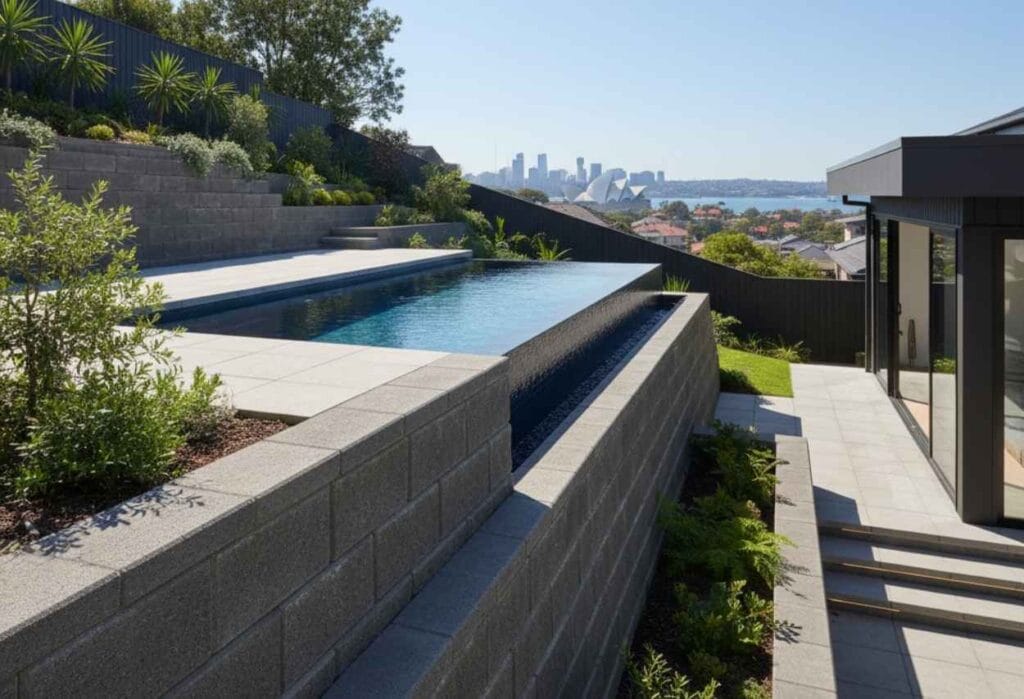
The surrounding area is finished with paving, decking, or landscaping to tie the pool into the yard. On a sloped site, this is where the aesthetic potential really shows. A split-level deck stepping down to the pool, or a platform built to make the pool appear to float, can produce results that genuinely transform a difficult yard into a standout outdoor space.
Cost Breakdown: What to Expect When Installing on a Slope
Costs vary depending on slope severity, soil conditions, access, and the level of finishing you want. The table below provides a general breakdown for a Brisbane sloped site installation.
| Cost Component | Flat Site (Estimate) | Sloped Site (Estimate) |
|---|---|---|
| Precast pool supply | $15,000–$30,000 | $15,000–$30,000 |
| Excavation | $3,000–$6,000 | $6,000–$14,000 |
| Retaining walls | Minimal | $5,000–$20,000+ |
| Engineering and permits | $1,500–$3,000 | $3,000–$8,000 |
| Crane hire | $1,000–$2,500 | $1,500–$4,000 |
| Paving and surrounds | $4,000–$10,000 | $6,000–$15,000 |
| Plumbing and electrical | $3,000–$6,000 | $3,500–$7,000 |
| Total (approximate) | $27,500–$57,500 | $40,000–$98,000+ |
These are indicative figures based on typical Brisbane projects. A steep, difficult-access block in a suburb like Taringa or The Gap could push well above the upper end of this range. Always get at least three itemised quotes before committing.
Choosing the Right Installer for a Sloped Brisbane Block
Not every pool company has experience with sloped site installations. It is a genuinely more complex job than a flat block, and the difference in outcomes between an experienced installer and a generalist can be significant. When evaluating installers, ask these specific questions:
- Have they completed precast installations on sloped blocks in Brisbane, and can they provide photos or references from those projects?
- Do they manage the engineering, permits, and retaining works in-house, or will you need to coordinate multiple separate contractors?
- What is their crane access plan for your specific block?
- How do they manage stormwater drainage as part of the finished project?
- Are they licensed with the QBCC, and will the installation carry the appropriate structural warranty?
Plunge Pools Brisbane specialises in precast plunge pool installation, custom plunge pools, above ground plunge pools, and inground plunge pool installations across the Brisbane area. Our experience with the specific conditions Brisbane blocks present, including clay soils, tight access, and significant slope gradients, is directly relevant to getting this kind of project done properly.
A qualified installer will also help you navigate Brisbane City Council’s pool fencing and safety requirements, which apply regardless of pool type or site configuration. The Australian Government’s Pool Safety portal links through to state-specific requirements.
Things to Know
- Brisbane City Council requires a development application for retaining walls over 1 metre in height adjacent to a boundary. Check this early, as it adds time to your project timeline.
- Precast pools generally cannot be modified once manufactured, so getting the dimensions right during the design phase is critical, especially on a sloped block where space may be constrained.
- Clay soils in Brisbane’s western and southern suburbs can shift significantly during drought-then-rain cycles. An engineer who understands local soil conditions is not a luxury on these sites, it is a necessity.
- Above ground plunge pool configurations on sloped sites are sometimes more cost-effective because they reduce excavation depth, but they require robust structural support on the downhill side.
- Pool heating costs are similar regardless of slope, but if your pool ends up partially shaded due to a slope-facing orientation, factor in the extra running costs of a heat pump or solar heating system.
- Stormwater management is a condition of approval in Brisbane. Your installer needs to demonstrate that pool backwash and surrounding drainage will not adversely affect neighbouring properties.
Conclusion
A sloped block is not a reason to give up on a plunge pool. In many cases, it is an opportunity to create a tiered outdoor space that a flat yard could never produce. The key is understanding the real costs upfront, working with an installer who has hands-on experience with Brisbane’s specific site conditions, and investing in proper engineering from the start rather than trying to cut corners on structural work.
Installing precast plunge pools on sloped sites in Brisbane is a well-established process, and the results speak for themselves in the suburbs across this city where hillside pools have become a genuine feature of outdoor living. Start with a proper site assessment, get itemised quotes, and work with specialists who know the terrain.
Ready to Scope Your Sloped Site?
The most useful thing you can do right now is book a site-specific consultation with an installer who has genuine experience on Brisbane slopes. Bring your block’s survey plan if you have one, note the approximate slope gradient, and ask for an itemised quote that separates excavation, retaining, and pool supply costs. This gives you a clear picture of where the money goes and where there is room to adjust scope if needed. Contact Plunge Pools Brisbane to arrange an on-site assessment tailored to your block.
Frequently Asked Questions
How steep is too steep for a precast plunge pool installation in Brisbane?
There is no absolute cut-off, but slopes steeper than approximately 1 in 3 significantly increase engineering and retaining wall costs.
Most experienced installers can work with very steep blocks, but the project scope expands considerably. At extreme gradients, above ground configurations supported by engineered steel or concrete structures may be more practical than a fully inground installation.
Do I need council approval for a plunge pool on a sloped block in Brisbane?
Yes, most plunge pool installations in Brisbane require a building approval, and sloped sites often trigger additional development application requirements for retaining walls.
Brisbane City Council’s planning scheme sets out when a development application is required based on slope, proximity to boundaries, and retaining wall height. Your installer or a private building certifier can advise on the specific approvals needed for your site.
How long does the installation take on a sloped Brisbane block?
From excavation start to final inspection, a sloped site installation typically takes four to ten weeks, depending on engineering complexity and approval timeframes.
A flat block installation might be completed in two to four weeks. The additional time on a sloped site is largely driven by retaining wall construction, soil curing times, and the need for engineering sign-off at various stages.
Can a precast plunge pool be partially above ground on a sloped site?
Yes, a semi-inground or fully above ground configuration is a common solution on sloped Brisbane blocks and can reduce excavation costs.
The exposed portion of the pool shell is supported by retaining structures and can be clad in timber, stone, or concrete to match your landscaping. This approach often produces a more interesting aesthetic than a standard inground installation.
What soil types in Brisbane are most problematic for sloped pool installations?
Expansive clay soils, which are common in Brisbane’s western suburbs, are the most challenging because they swell and shrink with moisture changes.
This movement can place stress on pool shells, retaining walls, and footings over time. A geotechnical assessment helps identify the soil type and determine the appropriate footing design to manage this risk effectively.